Carnegie Hall
ADA compliance and interior refit across all five curvilinear audience levels of the Isaac Stern Auditorium. Completed in three months. The concert schedule did not pause.
Carpentry & Protection
881 Seventh Avenue, New York, NY
Confidential
Carnegie Hall Corporation
GEM Construction Iu + Bibliowicz Architects
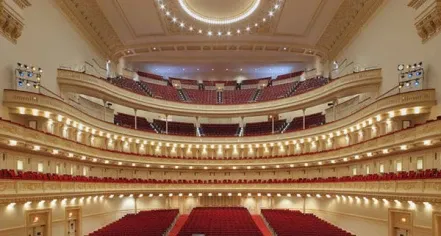
Opened in 1891 and designed by William B. Tuthill for Andrew Carnegie, the Hall became the world standard for concert hall acoustics and architectural excellence within years of its opening. Declared a National Historic Landmark in 1962, it has since undergone carefully managed restorations to preserve its sound integrity and 19th-century character. By 2010, comprehensive accessibility modernization was essential to meet evolving ADA standards while maintaining the building's historic finishes, acoustic performance, and uninterrupted operational continuity.
Technical
Scope
GEM Construction
Iu + Bibliowicz Architects
Confidential
The 2010 ADA Compliance Project delivered comprehensive accessibility across all five curvilinear audience levels — establishing accessible routes, dispersed seating, and assistive listening infrastructure without compromising acoustics or design authenticity. The project included complete hall recarpeting with acoustically balanced underlayment and a historically faithful color palette. All booths and public areas were finished with environmentally responsible, low-VOC coatings. Work was completed in an unprecedented three-month period using a continuous 24/7 rotation of three eight-hour shifts with deliberate one-hour overlaps between crews — enabling handoff communication rather than a cold start/stop protocol — allowing Carnegie Hall to maintain its full concert schedule without a single cancellation.
Custom acoustically fastened plywood subfloors were fabricated and installed throughout all seating booths and balcony platforms to ensure vibration isolation and preserve sound integrity. Existing stepped risers were modified; new level platforms were added to achieve barrier-free circulation and proper sightlines. Wood seating bases and trims were adjusted to match original profiles after wheelchair seating reconfiguration. Bronze-finish rail support blocking and anchorage framing were coordinated with ornamental metalwork to preserve visual alignment. Door jambs and thresholds were reinforced for smooth transitions not exceeding one-half inch. Finish carpentry included reinstalling custom moldings and trims, restoring select wall panels affected by platform changes, and coordinating carpet scribing along thresholds, curved walls, and stage perimeters.
Protection measures focused throughout on non-invasive, reversible methods. Acoustically transparent containment barriers isolated work zones while controlling air and dust. Custom scaffold wraps and edge guards shielded plaster, murals, and woodwork. Real-time vibration monitoring protected acoustic integrity. Breathable, non-adhesive films covered marble, parquet, and brass throughout. All fastenings were fully reversible to preserve historic substrates — a practice adopted as standard for all subsequent GCC landmark projects.
The Founding
Partners
The Founders of GCC oversaw the carpentry and protection scopes, ensuring all installations met Carnegie Hall's exacting standards for craftsmanship and preservation. Their team executed precise carpentry detailing — from subfloor and platform modifications to finish trim restoration — while implementing comprehensive, non-invasive protection measures that safeguarded the Hall's historic plaster, gilding, and decorative finishes throughout construction.




Project
Outcome
The project set a new benchmark for integrating ADA compliance, environmental performance, and heritage preservation — achieving full accessibility across all five audience levels while maintaining Carnegie Hall's historic integrity. Completed on schedule within 90 days without interrupting a single performance. Precision today, legacy for tomorrow.